Sports & Entertainment · Student-Athletes
The Scholarship Is Not the Strategy: A Louisiana Student-Athlete's Guide to Finding College Opportunities
Understanding D1, D2, D3 and JUCO opportunities, NCAA eligibility, Louisiana resources like TOPS and FAFSA, and why a complete athletic profile matters more than a highlight reel.
By Jaylen Sinegal · September 24, 2026 · 25 min read
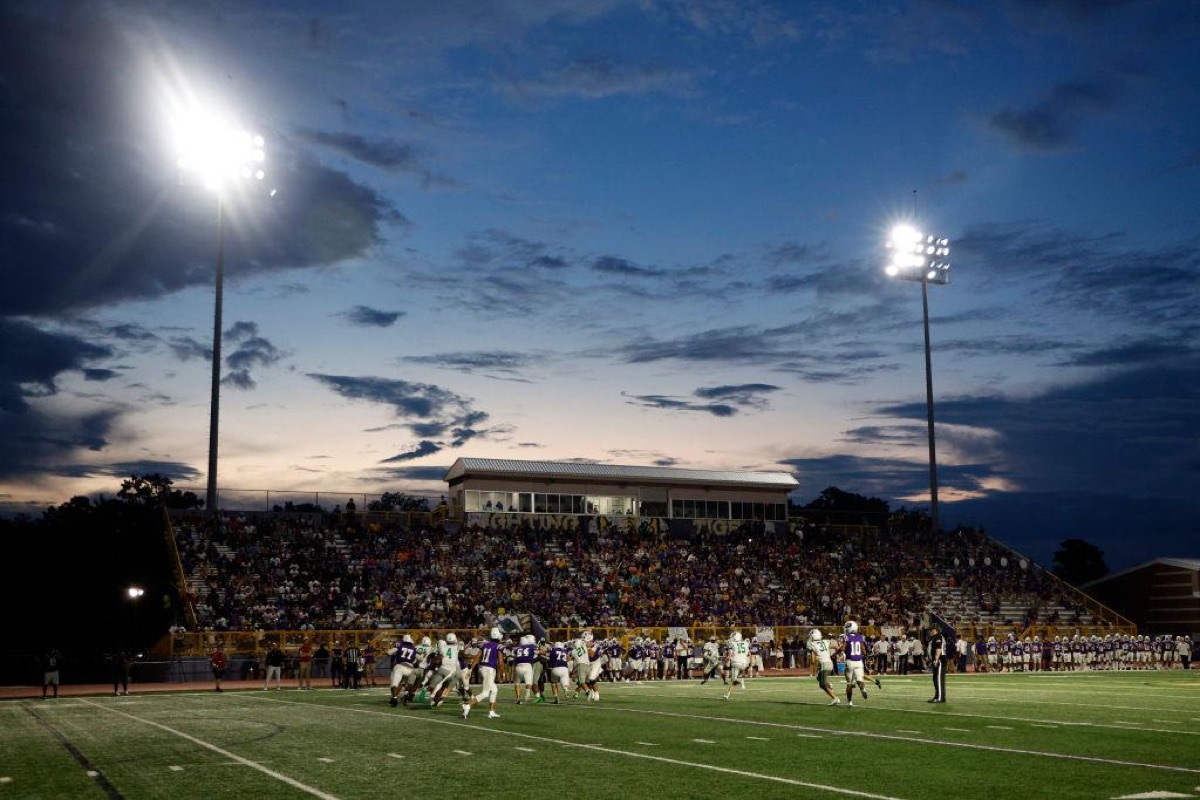
Every family with a promising athlete eventually hits the same wall:
They have the talent. They have the grades. They have a coach telling them "you can play in college."
And then they start waiting.
They wait for a college coach to call. They wait for a scholarship to show up. They wait to be discovered.
I want to suggest a different approach.
College athletics is not a lottery where some families get selected. It's a market, and the families who understand the market get more of what the market actually has to offer.
The scholarship isn't the strategy.
The strategy is understanding the opportunity system around you, meeting its requirements, and building a documented identity that makes it easy for a college to say yes.
This guide is written for Louisiana families, because Louisiana families are in a unique position: this state has Division I universities, HBCUs, private colleges, community colleges, NAIA programs, and junior colleges across the state. A student-athlete does not have to leave Louisiana to begin building a college athletic career.
A 2026 eligibility transition to know about: NCAA guidance says prospects first enrolling full-time in 2026-27 can be evaluated under either the previous rules or the newer age-based rules, whichever is more favorable. Prospects enrolling in fall 2027 or later fall under the age-based rule. So the exact numbers here can shift, and college financial-aid policies vary by school. Verify current requirements directly with the NCAA Eligibility Center, your school's athletic department, and the financial-aid office.
And if you're here for the execution, not the education, the second part of this series is the step-by-step playing kit: How to Get Started as a College Student-Athlete. This guide is the theory. That one is the ten-step operating system.
1. THE SCHOLARSHIP IS NOT THE STRATEGY
Let's start with the honest math that recruiting content usually skips.
Most high school athletes will not receive an athletic scholarship. Roughly 2 percent of high school athletes go on to receive any athletic scholarship money in college, at any level.
That doesn't mean college athletics isn't worth pursuing. It means the pursuit has to be smarter than "wait for the full ride."
Because the truth is that college athletics involves many forms of opportunity, and athletic scholarships are only one piece of it.
- Athletic scholarships.
- Academic scholarships.
- Need-based financial aid.
- Institutional scholarships.
- Grants.
- Walk-on opportunities.
- JUCO and NAIA pathways that create scholarships two years later.
- State programs like Louisiana TOPS that pay tuition regardless of athletics.
A family that only chases the athletic scholarship is leaving the rest of the system on the table.
Think about it the way I think about personal brand:
You don't build a career by waiting for a company to discover your talent. You build a documented identity that makes your talent easy to see, verify, and invest in.
Same thing here. A college coach doesn't need to "discover" you.
They need to be able to find you, verify you, and justify you to their compliance office and financial-aid office.
Your job as the athlete (and the family) is to make every one of those steps easy.
The scholarship isn't the strategy. The strategy is building the profile, understanding the levels, meeting the requirements, and using every financial tool available so that when opportunity shows up, you're already positioned for it.
2. KNOW THE DIFFERENCE: D1, D2, D3 AND JUCO
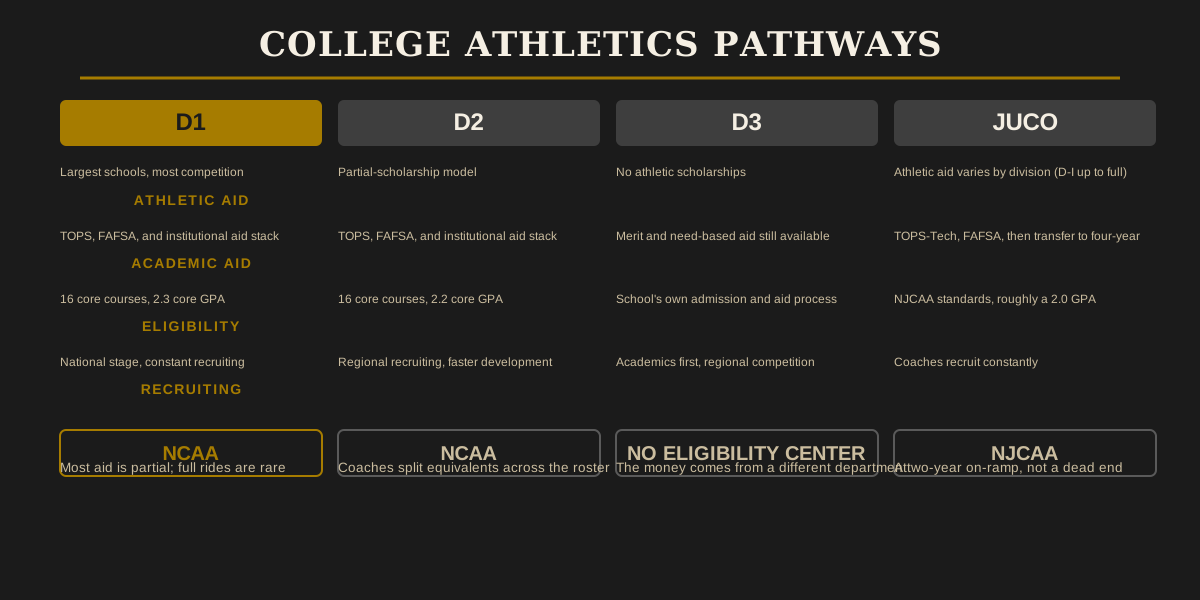
Families hear "Division I" and assume it's the only real option. It's not. It's the biggest and most visible, but it's also the most competitive, and it's not the right fit for every athlete.
NCAA Division I
- The largest schools with the largest athletic budgets, the most media exposure, and the most scholarship money.
- Historically, "full rides" were guaranteed in head-count sports: FBS football, men's and women's basketball, women's volleyball, women's gymnastics, and women's tennis. Other sports shared a limited pot across the roster (equivalent to a few full scholarships split many ways).
- Everything changed for 2025-26. Under the House v. NCAA settlement, scholarship limits were removed for schools that opted in and replaced by roster limits. Football rosters cap at 105, baseball at 34, basketball at 15, softball at 25. Sport-level scholarship caps are gone, which means partial scholarships are now legal even in football and basketball.
- The National Letter of Intent was eliminated for Division I in 2024.
- Reality: about 57 percent of Division I athletes receive some athletics aid, and most of that is partial. Division I remains the hardest level to earn a roster spot at.
NCAA Division II
- Division II is built on the partial-scholarship model. There are no "head-count" full-ride sports; every sport works off equivalencies that coaches split across the roster (for example, roughly 36 football equivalents, 10 in basketball, 9 in baseball).
- A Division II coach can give one player a percentage of a scholarship and adjust the rest around it. Very few D2 athletes get a scholarship that covers full cost.
- About 62 percent of D2 athletes receive athletics aid.
- Because it's less famous but still real college athletics, D2 can mean more playing time and quicker development.
NCAA Division III
- Important: Division III does not award athletic scholarships. It's NCAA rule: D3 schools may not give financial aid on the basis of athletics participation, leadership, ability, or performance.
- "No athletic scholarship" does not mean "no financial aid." About 80 percent of Division III athletes receive institutional, merit, or need-based financial aid.
- Division III emphasizes academics and athlete well-being. No athletic scholarship pressure means athletes are treated like all other students, with shorter seasons and regional competition.
- D3 is a legitimate path for athletes who want to play college sports seriously while putting academics first. The money just comes from a different department.
NJCAA / Junior College (JUCO)
- JUCO is a legitimate pathway, not a Plan B. Junior college is a two-year on-ramp: it's how thousands of athletes reach four-year schools with eligibility remaining.
- Scholarship rules vary by NJCAA division: NJCAA D-I can fund full scholarships (tuition, fees, books, room and board, plus supplies and one-time transportation); NJCAA D-II is limited mostly to tuition, fees, books, and supplies; NJCAA D-III offers no athletic scholarships.
- The JUCO-to-four-year transfer pipeline just became easier: in summer 2026, the NCAA brought two-year-college transfers under the same eligibility framework as four-year transfers, removing the old additional hurdles JUCO transfers had to clear.
- In Louisiana, junior colleges like LSU Eunice, Delgado, and Baton Rouge Community College routinely move athletes to four-year programs. LSU Eunice alone has sent hundreds of baseball players to four-year schools.
The takeaway: "athletic scholarship" is not one thing. It's several different systems, each with its own rules. The level that fits your athlete is the level where they can actually compete, grow, and get their education supported.
3. ELIGIBILITY COMES BEFORE THE OFFER
Here's the part families miss the most.
A coach can want you. A school can love you. And none of it matters if you're not academically eligible, because the NCAA will not certify you, and the school cannot put you on scholarship or play you.
Eligibility comes before the offer. Every time.
For Division I and Division II, that process runs through the NCAA Eligibility Center.
What you actually have to qualify for
Separate these two: athletic opportunity and eligibility are not the same gate. A coach can want an athlete and a school can love them, and none of it matters if the eligibility gate stays shut. For D1 and D2, both doors, the athletic evaluation and the academic certification, run through the Eligibility Center, and each one has to open in its own time.
- Register early. The NCAA recommends registering before ninth grade and building the certification account as early as middle school. At minimum, make sure registration is done before the end of the junior year so your coursework can be reviewed on time. Registration costs $110 for domestic academic and athletics certification (as of September 2025), with fee waivers available for families that qualify.
- D1 academics: 16 NCAA-approved core courses, including 4 English, 3 math, 2 natural/physical science, 1 additional English/math/science, 2 social science, and 4 additional core courses, plus a minimum 2.3 core-course GPA. A "10/7" rule requires 10 of the 16 core credits (including 7 in English, math, or science) to be completed before senior year.
- D2 academics: 16 core courses with a slightly different distribution and a 2.2 core-course GPA minimum. Division II also allows a partial qualifier route.
- No more test-score requirement for the NCAA. Divisions I and II permanently removed ACT/SAT from initial-eligibility requirements for students enrolling on or after August 1, 2023. Keep taking the ACT anyway. Colleges may still want it for admission and for your own academic scholarship options, but the NCAA no longer requires it for eligibility.
The GPA detail families miss
There are two different GPAs in this conversation, and they are not the same number.
Your high school's transcript GPA is calculated by your school and includes everything your school counts.
The NCAA core-course GPA is calculated only from NCAA-approved core courses, on an unweighted 4.0 scale, with the highest grade used when a course is repeated.
Families find this out the hard way: a student with a beautiful 3.8 transcript GPA can walk into the Eligibility Center and discover their core-course GPA is a 2.4, because their school's weighted bonus points don't count the same way.
That is exactly the kind of detail that changes an athlete's future, and exactly why you cannot wait until senior year to check. Your counselor can run a core-course evaluation on the Eligibility Center's high school portal. Do it in the 9th or 10th grade and fix course selection early, while you still can.
How the timing works
- End of junior year: counselor submits your official transcript for an initial review.
- After graduation: counselor submits the final transcript and proof of graduation.
- Certification only actually begins when a college puts you on its institutional request list, so a school has to be recruiting you for the final approval to happen. You cannot "pre-certify" fully on your own.
- Processing time is about 20 business days once everything is in the queue. Late paperwork is the enemy.
Start earlier than senior year (or junior year)
The NCAA explicitly encourages early registration: students can begin engaging with the Eligibility Center as early as sixth grade, with different account considerations depending on where they are in the process. The point isn't to file paperwork as a middle-schooler. It's to make the sequence strategic.
College recruiting shouldn't begin when a teenager suddenly realizes they need a scholarship. The preparation starts years earlier, through academics, competition, documentation, and relationship-building. The Eligibility Center account is just the formal version of what should already be happening: a family managing a college opportunity on purpose, instead of reacting in a panic during junior and senior year.
Division III does not use the NCAA Eligibility Center, and NAIA schools use the NAIA Eligibility Center instead. Junior colleges have their own academic eligibility rules (roughly a 2.0 GPA and enough accumulated credits to stay in good standing). Each level has its own gate. Learn which gate opens the path you actually want.
4. WHERE LOUISIANA STUDENT-ATHLETES CAN ACTUALLY SEARCH
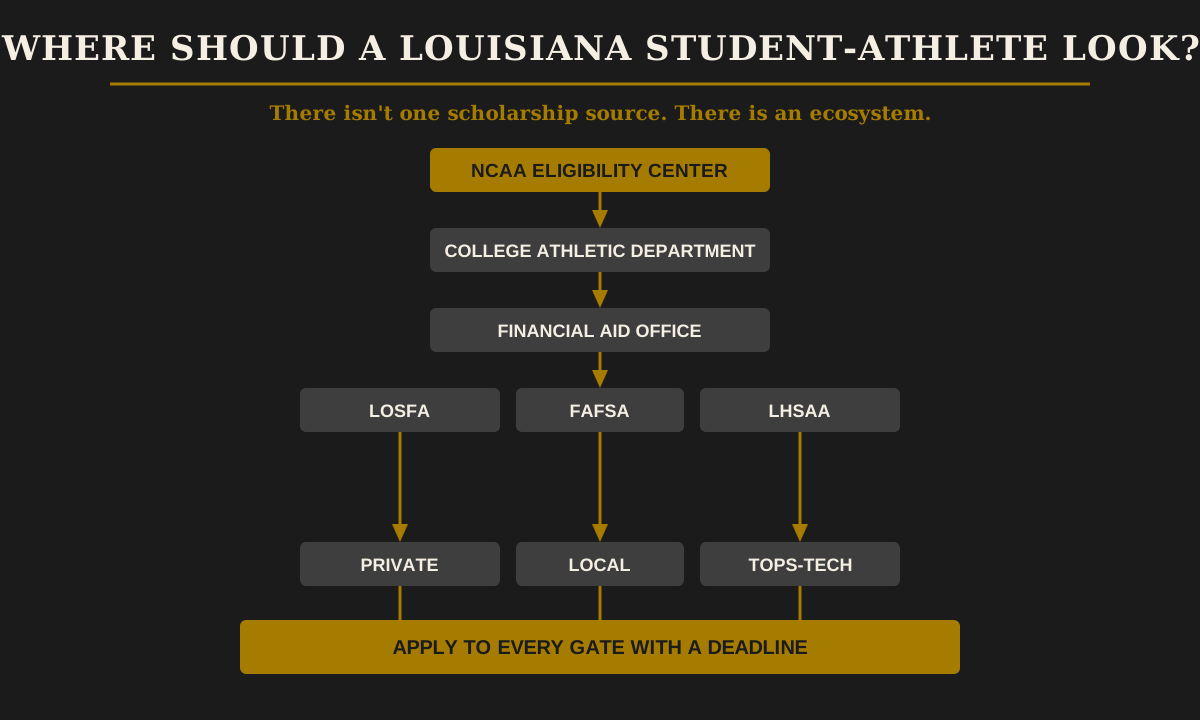
Here is the resource section. Each item has a direct link and what you should actually do there. Bookmark this part.
The NCAA / national tools
- NCAA Eligibility Center: ncaa.org/eligibility-center. Register, build your academic record, track your core-course and amateurism status. This is step one for any D1 or D2 prospect.
- NCAA Scholarships & Financial Aid: ncaa.org. The official breakdown of athletic aid rules, division differences, and what "full ride" actually means. Read it with your athlete so you both speak the same language.
- FAFSA: studentaid.gov. Free, and the gateway to Pell Grants, federal loans, work-study, and most need-based aid. It's also required for TOPS. The 2027-28 FAFSA opens to everyone by October 1, 2026. Fill it out every year, even if you think you won't qualify.
Louisiana financial aid that stacks on top of athletics
- LOSFA: mylosfa.la.gov. The Louisiana Office of Student Financial Assistance administers TOPS, the LA GO Grant (need-based), the M.J. Foster Promise Program, and national guard scholarships. Track everything in the LOSFA Student Hub.
- TOPS (Taylor Opportunity Program for Students): Louisiana's merit scholarship, funded by the state for qualifying residents, on top of whatever athletic or other aid you receive. Four core award levels, based on ACT and high school GPA:
| Award | ACT | GPA | What it covers |
| TOPS Opportunity | 20 | 2.50 | Tuition and fees |
| TOPS Performance | 23 | 3.25 | Tuition and fees + book stipend |
| TOPS Honors | 27 | 3.50 | Tuition and fees + larger book stipend |
| TOPS Excellence | 31 | 3.50 | Tuition and fees, or up to $12,000, whichever is less |
| TOPS-Tech | 17 (or GED) | 2.50 | Two-year and technical programs |
- Apply for TOPS through the FAFSA or a LOSFA application by July 1 of each award year. At LSU, the current TOPS Opportunity award covers roughly $7,400+ of tuition and fees; amounts vary by school.
- LHSAA: lhsaa.org. Beyond regulating Louisiana high school athletics, LHSAA sponsors the Coca-Cola scholarships (typically two $1,500 awards, one male and one female) and recognizes senior student-athletes through its All-Academic program. Check their scholarships page each year.
- LHSCA: Louisiana High School Coaches Association (lhsaa.org/lhsca). Administers scholarships for the children of its member coaches. If your family includes a Louisiana high school coach, this matters.
- LOSFA's scholarship search: mylosfa.la.gov. The state's own database aggregates outside scholarships and institutional opportunities and points students toward tools like Fastweb, Niche, CareerOneStop, and Scholarships.com. This is where Louisiana itself tells students to look, a real advantage over "just Google scholarships."
The people who actually make decisions
- College financial-aid offices. Every college in Louisiana has one. Ask for their institutional scholarships, merit money, grants, and any athlete-specific aid beyond athletics. This is where TOPS and Pell information, plus school-specific packages, actually come together.
- Athletic departments and recruiting coordinators. The coach is busy coaching. The recruiting coordinator or sports-information office handles prospects, camp/film submissions, and unofficial visits. Learn who that person is at each target school and build the relationship.
- Junior colleges. LSU Eunice, Delgado, Baton Rouge CC, Bossier Parish CC, Nunez, and Southern University at Shreveport all run athletic programs. Their coaches are some of the most accessible in the country. JUCO programs recruit constantly.
- Scholarship-search platforms. Use free, reputable databases and treat them as supplements, not the main plan. Never pay money to "apply" for a scholarship; legitimate applications don't cost anything.
Here's the pattern in every one of these resources: they all reward the athlete who shows up prepared and organized. The family that registers early, files the FAFSA, meets the July 1 deadline, and tracks every deadline in writing gets more out of the same system.
And the money can stack. A Louisiana student-athlete can pair an athletic scholarship with TOPS, the LA GO Grant, Pell, and institutional aid, subject to the rules of each program and the school's own financial-aid policies. An athletic offer doesn't replace TOPS, and TOPS doesn't replace the FAFSA. Each one is a separate application with a separate deadline, and families who treat them as one combined "money plan" get further than families who chase a single number.
5. DON'T JUST LOOK AT LSU
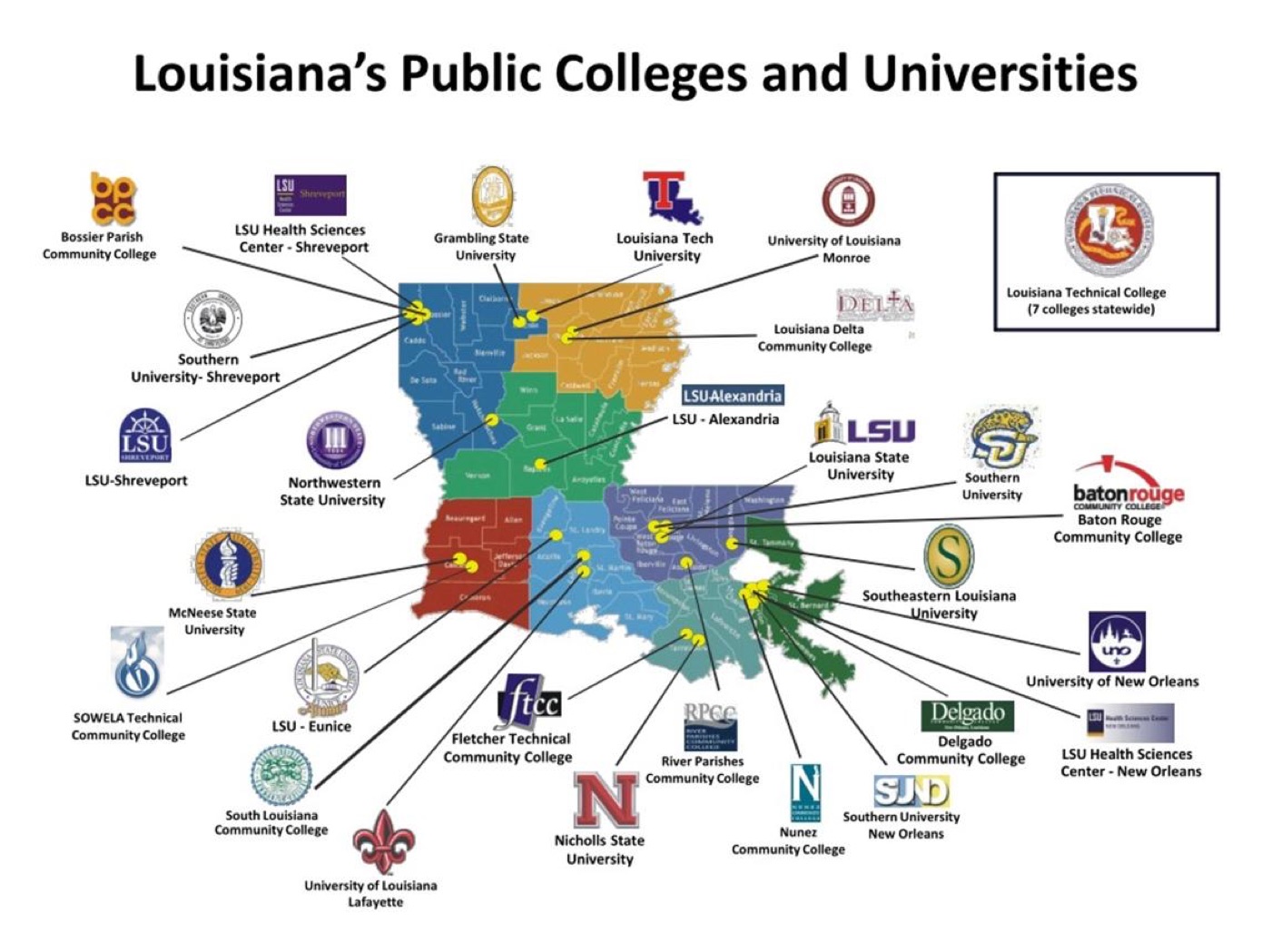
Louisiana has a bigger college athletics map than most families ever see. And because every level has different recruiting and financial-aid realities, "the LSU dream" is not the only path, and for many athletes, it isn't even the best one.
NCAA Division I in Louisiana
- LSU (Baton Rouge): SEC. The state's flagship D1 program.
- Tulane (New Orleans): American Athletic Conference.
- University of Louisiana at Lafayette: Sun Belt.
- ULM (Monroe): Sun Belt.
- Louisiana Tech (Ruston): Sun Belt, as of July 1, 2026.
- McNeese (Lake Charles): Southland.
- Southeastern Louisiana (Hammond): Southland.
- Nicholls (Thibodaux): Southland.
- Northwestern State (Natchitoches): Southland.
- LSU New Orleans (the former UNO, renamed July 1, 2026): Southland.
- Grambling State: SWAC, HBCU.
- Southern (Baton Rouge): SWAC, HBCU.
That's twelve Division I programs in one state, spanning SEC, Sun Belt, Conference USA, Southland, and SWAC. Between them they cover football, basketball, baseball, softball, soccer, track, volleyball, gymnastics, golf, and more. And every one of them has a financial-aid office and a recruiting coordinator.
NCAA Division II and Division III in Louisiana
- Today, Louisiana has no Division II schools: but that changes soon: Loyola University New Orleans was accepted into the Gulf South Conference (NCAA Division II), joining in fall 2027 with full D2 status expected around 2029-30.
- Louisiana has one Division III school: Centenary College of Louisiana in Shreveport (Southern Collegiate Athletic Conference), where athletes compete without athletic scholarships but with strong institutional aid.
NAIA in Louisiana
- Xavier University of Louisiana (New Orleans): NAIA.
- Loyola New Orleans: NAIA today, D2 transition as noted above.
- LSU Alexandria: NAIA.
- LSU Shreveport: NAIA.
- Louisiana Christian (Pineville): NAIA.
- Dillard (New Orleans): NAIA, HBCU.
- Southern University at New Orleans: NAIA, HBCU.
NAIA schools award athletic scholarships too, have their own (easier) eligibility center, and often offer immediate playing time.
Junior college (NJCAA) in Louisiana
- Delgado Community College (New Orleans): NJCAA Division I.
- LSU Eunice: NJCAA (baseball moved to NJCAA D-I in 2025; softball competes D-II; basketball and soccer D-I).
- Baton Rouge Community College: NJCAA.
- Nunez Community College (Chalmette): NJCAA.
- Bossier Parish Community College: NJCAA.
- Southern University at Shreveport: NJCAA.
The point isn't that any one of these schools is "better."
The point is that Louisiana answers the question across every level, D1, D3, NAIA, JUCO, HBCU, and community college, and a family should match the athlete's realistic path and goals to the level, not the other way around.
6. LOUISIANA ATHLETES ARE ALREADY DOING IT
Instead of generic "success stories," here are real athletes currently competing at the college level, verified from official roster pages and school announcements. Read the pathways, because the variety is the whole point.
Division I
- Harlem Berry: New Orleans → St. Martin's Episcopal School → LSU football, running back. A five-star signee now in the LSU backfield.
- Richard Anderson: New Orleans → Edna Karr High School → LSU football, defensive line. A five-star, No. 1-ranked defensive line signee.
- Dez Ellis: Wisner → Franklin Parish High School → LSU football, cornerback.
- JaKolby Jones: Many → Many High School → Copiah-Lincoln Community College (JUCO) → LSU football, offensive line. A JUCO-to-LSU route.
- Jack Ruckert: Baton Rouge → Catholic High School → LSU baseball, infield. The 2025 No. 1 high school player in Louisiana.
- William Patrick: Monroe → St. Frederick High School → LSU baseball, outfield.
- Daniel Harden: Prairieville → Catholic High School → McLennan Community College (JUCO) → LSU baseball, outfield. Two years at JUCO, then LSU.
- Maci Bergeron: Rayne → Notre Dame High School → LSU softball. The Acadiana-to-LSU pattern.
- Alix Franklin: St. Amant → St. Amant High School → LSU softball, infield. A three-time Louisiana 5A state champion.
- Victoria Roberts: Belle Chasse → EDGE Gymnastics → LSU gymnastics. A homeschooled athlete who earned a scholarship.
- Jada Richard: Opelousas → Lafayette Christian Academy → LSU women's basketball, guard. Gatorade Louisiana Player of the Year.
- Mikaylah Williams: Bossier City → Parkway High School → LSU women's basketball, guard.
- Marley Richard: Destrehan → Destrehan High School → LSU track and field. An eight-time Louisiana state champion.
- Walker Howard: Lafayette → St. Thomas More → UL Lafayette football, quarterback. A transfer who returned home to Acadiana.
- Aiden Falgout: Lafayette → St. Thomas More → UL Lafayette football, tight end. Joined the Ragin' Cajuns as a preferred walk-on.
- Kenneth Bannister: New Orleans → Edna Karr High School → Louisiana Tech football, offensive line.
- Omiri Wiggins: Lafayette → Acadiana High School → Coffeyville Community College (JUCO) → Louisiana Tech football, running back.
- A'Yiana Flemings: New Orleans → Ursuline Academy → Three Rivers Community College (JUCO) → McNeese women's basketball.
- Jamar'i Bell: Shreveport → Huntington High School → McNeese women's basketball.
- Jason Gabriel: New Orleans → John Curtis → Southern University football. The HBCU route.
- Lyndon Vallery: New Orleans → McDonogh 35 → Southern University football. Another McDonogh 35 to the Red Stick.
- Lillie Mazur: Houma → Vandebilt Catholic → Nicholls women's soccer.
- Angelina Rispone: Baton Rouge → St. Joseph's Academy → Nicholls women's soccer.
JUCO → four-year
- Tyson LeBlanc: Maurice → North Vermilion High School → LSU Eunice (JUCO) → Kansas baseball. A Cajun Country JUCO-to-Big 12 transfer.
- Hudson Spangler: Zachary → Zachary High School → LSU Eunice baseball, pitcher. Building the JUCO résumé, on the same roster pipeline that produced the LeBlancs above.
NAIA
- EJ McQuillan: Port Allen → Port Allen High School → LSU Alexandria men's basketball.
- Jordan Decuir: Baton Rouge → Zachary High School → LSU Alexandria men's basketball (after LSU Shreveport).
- Thomas Walker: Baton Rouge → University Lab → Xavier University of Louisiana men's soccer.
- Nico Jones: Baton Rouge → Catholic High School → LSU Shreveport men's basketball.
Division II (out of state) and Division III
- Neno Lemay: New Roads → West Feliciana High School → Nicholls State (FCS) → Delta State (Mississippi) football, wide receiver. An FCS-to-D2 route.
- LeDell Finister: New Orleans → Creekside High School → Campbell (FCS) → Delta State (Mississippi) football, offensive line.
- Aron Gillum: Shreveport → Captain Shreve High School → Centenary baseball. Division III, no athletic scholarship, full institutional experience.
- Turner McLelland: Minden → Glenbrook School → LSU Eunice (JUCO) → Centenary baseball. A JUCO-to-D3 route.
Read that list again and notice the pattern: Louisiana kids are reaching every level. Five-star direct signees. Preferred walk-ons. JUCO-then-LSU. JUCO-then-Kansas. HBCU programs. NAIA programs. D3 programs. FCS-to-D2 transfers. Same talent market, different routes.
A kid in Lafayette can see a Lafayette athlete. A kid in New Orleans can see another New Orleans athlete. A kid in Wisner can see a kid from Franklin Parish High School on an SEC roster. This isn't a fantasy. It's already happening.
7. YOUR ATHLETIC RÉSUMÉ IS BIGGER THAN A HIGHLIGHT REEL
Here's where this comes back to brand strategy, because this is the part that separates the families who understand the market from the ones who don't.
Every athlete has film now. Everybody's phone records everything. A highlight reel is table stakes; it proves you can do a thing on video.
A reel alone doesn't tell a coach whether you're academically eligible, whether you've been cleared by the Eligibility Center, whether you've got the grades to stay eligible, whether you're reliable, or whether you're a good teammate.
A highlight reel shows what you can do. A complete athlete profile shows who you are, what you've accomplished, how you've developed, and where you're going.
So build the full profile. Keep a running, organized record of:
- Academic record: transcript, core-course GPA, ACT/SAT scores, honors classes, class rank.
- Athletic statistics: season-by-season numbers that let a coach project you.
- Verified testing: 40-yard, pro-agility, bench, vertical, and other documented combine numbers from credible sources.
- Competition history: opponents, tournaments, showcases, and state/regional results.
- Film: updated, labeled, and organized by season, with the best stuff first.
- Awards: all-district, all-state, national honors, and school records.
- References: coaches, trainers, counselors, and teachers who will answer a call.
- Interviews: short video answers coaches can review without a phone call.
- Community involvement: service, church, volunteer work, leadership.
- Social presence: professional, clean, and consistent with the identity you're building.
- Recruiting contacts: every coach, coordinator, and recruiter you've spoken with, and what was said.
- Scholarship applications: dates, deadlines, and status for every application in play.
- Financial-aid documentation: FAFSA completion, TOPS application, and school financial-aid filings.
This is documented identity. It's the personal-brand version of recruiting, and it works because coaches and compliance offices are drowning in unorganized, unverified prospects. Being organized is a competitive advantage that costs nothing but discipline.
8. BUILD A COLLEGE OPPORTUNITY TRACKER
This is a working file, not a reading exercise. Fill it in as you go: every school becomes a row, every deadline gets a date. The rows below are examples, not recommendations. Replace them with your own list.
Download this tracker as CSVDon't carry this in your head. Build a tracker, a spreadsheet, a document, whatever works, and update it every time you touch a school. Here's the framework to copy.
| School | Division | Sport | Coach Contacted | Academic Requirements | Athletic Requirements | Scholarship | Financial Aid | Application Deadline | Status |
| LSU | D1 | Football | Coach X: sent film 9/1 | 2.3 core GPA; Eligibility Center | Verified 40-yd, showcase invite | Partial available | TOPS + FAFSA filed | 11/15 | Waiting on camp date |
| LSU Eunice | JUCO D1 | Baseball | Recruiting coord.: call scheduled | HS diploma; 2.0 standing | Camp + film | NJCAA D-I (up to full) | TOPS-Tech / FAFSA | Rolling | Pending |
| Centenary | D3 | Baseball | Coach: unofficial visit done | Institutional admission | Recruited athlete | None (no athletic aid) | Merit + TOPS + FAFSA | Check portal | Interested |
One row per school. If a row has empty cells, you haven't finished the work on that school. This single habit, writing down the market you're in, is the entire difference between organized families and families who say "we didn't know."
9. THE LOUISIANA ADVANTAGE
Here's the argument I want to leave you with.
Louisiana has major universities, HBCUs, private colleges, community colleges, and smaller institutions across the state. That means a student-athlete doesn't necessarily have to leave Louisiana to begin building a college athletic career.
Not liking it. Just stating the structural reality:
- Proximity. Family can be at the game. Support systems stay intact through the hardest transition a young athlete will ever make.
- Cost. TOPS money plus in-state tuition plus athletic money combine differently at home than anywhere else in the country. For many families, staying in state is the difference between debt and no debt.
- Playing time and development. A realistic level where you actually compete is better than a prestigious roster where you never play. Louisiana's D1, NAIA, and JUCO mix lets families choose competition level deliberately.
- The HBCU tradition. Grambling, Southern, Xavier, Dillard, and SUNO carry a century of culture, community, and athletic history that power the New Orleans-to-ACADIANA corridor.
- The pipeline works. LSU Eunice to Kansas. Delgado to four-year schools. McDonogh 35 to Southern. Edna Karr to LSU. John Curtis to Southern. The routes are proven because Louisiana families keep building them.
I'm not going to tell you which school is "better." I'm going to ask you the strategic question instead:
What does this opportunity actually provide the athlete?
Academics? Cost? A coach who will develop them? Realistic playing time? A brand they can build? A network they can use after sports? A pathway that keeps the door open to transfer up?
That's the whole point of this article. The scholarship is not the strategy.
The strategy is understanding the market, meeting its requirements, and positioning your athlete so the market sees them clearly.
Do that with the Eligibility Center, the FAFSA, TOPS, the tracker, and a complete athletic profile, and Louisiana will respond the way it always has: with opportunity.
10. THE SCHOOL IS NOT THE ONLY DECISION
Too many families pick a school by pointing at the biggest scholarship number. The scholarship is part of the decision, never the whole decision.
Evaluate the whole picture: academics + athletics + finances + environment + opportunity.
- Which degree? What does the school actually offer, and does it match what the athlete wants to do after sports?
- What's the remaining cost? Once the athletic aid is applied, what does the family actually owe?
- What's the projected role? Is this athlete legitimately competing for playing time, or depth on a roster?
- How strong is the program? The coach, the schedule, the development track, and the culture of the team.
- What academic support exists? Tutoring, study halls, degree planning, and advisors who know how to keep athletes eligible.
- What if the athlete gets injured? Who pays, and does the education still get finished?
- What if the coach leaves? Scholarships belong to the school, not the coach, but a coaching change can change everything about the fit.
- What if the scholarship isn't renewed?
- What happens after athletics? Does this school set the athlete up for life after sport?
On renewal, be realistic: NCAA athletics scholarships are generally awarded year-to-year, and renewal is not guaranteed. That's not a scare tactic. It's the reality families need to plan for, and exactly why the school, the degree, and the support system matter as much as the offer letter.

SOURCES AND REFERENCES
The facts in this post reflect the rules as I verified them in September 2026. These are summaries in my own words, not reproductions of copyrighted material. Always check the official sources directly, because eligibility and financial-aid rules change:
- NCAA Eligibility Center (ncaa.org/eligibility-center): core-course and GPA requirements, initial eligibility, and the age-based rule transition.
- NCAA Student-Athletes: Scholarships and Financial Aid: how athletic scholarships, equivalencies, and renewals actually work.
- FAFSA (studentaid.gov): the federal application required for federal and many state and institutional aid programs.
- LOSFA (mylosfa.la.gov): Louisiana TOPS, LA GO Grant, and other state financial aid programs and deadlines.
- Louisiana High School Athletic Association (lhsaa.org): eligibility and sanctioning for Louisiana high school athletics.
- Louisiana High School Coaches Association (LHSCA): high school endorsement forms and college orientations.
READY TO ACT? START WITH THE STEP-BY-STEP CHECKLIST
This guide is the landscape: what exists, how it works, and where Louisiana athletes fit into it. When the family has understood the system and is ready to run it like a process, go to the companion guide: How to Get Started as a College Student-Athlete: A Step-by-Step Scholarship and Recruiting Checklist. It's the operating system: exactly what to do, where to go, what to collect, and when to do it, step by step.
KEEP EXPLORING THE WORK
This guide is the first pillar in a conversation I intend to keep having about Louisiana sports, student-athletes, and building opportunity instead of waiting for it. When you're ready to execute, work through the step-by-step scholarship and recruiting checklist. If the HBCU path is on your list, start with my case for HBCU college athletics in Louisiana. Read my breakdown of the college sports NIL executive order and what it means for athlete branding, learn why being seen isn't the same as being remembered, go deeper into who I am and where this thinking comes from in Who Is Jaylen Sinegal?, or see how brand strategy applies to athletes, businesses, and families. Everything on Jay's Blog orbits the same idea: people who understand their market and build their identity don't have to wait to be discovered.