Sports & Entertainment · HBCU Recruiting
HBCU College Athletics in Louisiana: Recruiting, Scholarships, and the SWAC Advantage
Why an HBCU can be a strategy, not a fallback: Grambling, Southern, Dillard, Xavier, and SUNO, the athletic money that exists, the aid stack on top of TOPS and FAFSA, the honest NIL picture, and how recruiting works in the SWAC.
By Jaylen Sinegal · September 24, 2026 · 11 min read
I have watched too many families treat an HBCU as a fallback. As if applying to Grambling or Southern means they are settling. As if the only "real" opportunity sits in a Power Five logo.
That thinking is wrong, and it has cost Louisiana families for decades. This state has some of the most historic, most recognizable HBCUs in the country, and for a lot of athletes the smartest play in the room is a SWAC jersey, not a Power Five wish.
I want to make the case for treating HBCU college athletics as a strategy, not a consolation prize.
This isn't a scholarship directory, and I'm not going to promise you money that doesn't exist. My job here is the same as in my guide to finding college opportunities: help you understand how the system actually works, where the money lives, and what the honest recruiting reality is.
1. WHY AN HBCU IS A STRATEGY, NOT A FALLBACK
Here is the part most families never hear: the recruiting conversation and the money conversation are not the same conversation. A Power Five school can give you a bigger name and a tougher road to playing time. An HBCU can give you a real shot at early playing time, a coaching staff that knows the recruiting market, a community that treats you like family, and a degree from an institution with a legacy your grandfathers and grandmothers built.
When I look at an HBCU, I see four things working at once:
- Playing time. Coaches at HBCUs recruit hard, but the roster math is different. Fewer five-star commitments means more legitimate opportunity to compete for a spot from day one.
- Visibility. The Bayou Classic, the big SWAC matchups, and the conference brands put Grambling and Southern in front of national audiences every season.
- Community. HBCUs are the rare institutions where the culture is part of the education. That matters for an athlete's confidence, and confidence shows up in performance.
- The aid stack. Athletic money plus TOPS plus FAFSA plus HBCU-specific scholarships can combine in ways a lot of families never map out.
None of this means an HBCU is the right school for everyone. It means it can't be dismissed by default.
2. THE FIVE HBCUs IN LOUISIANA
Louisiana has five four-year HBCUs, and they split into two very different athletic worlds.
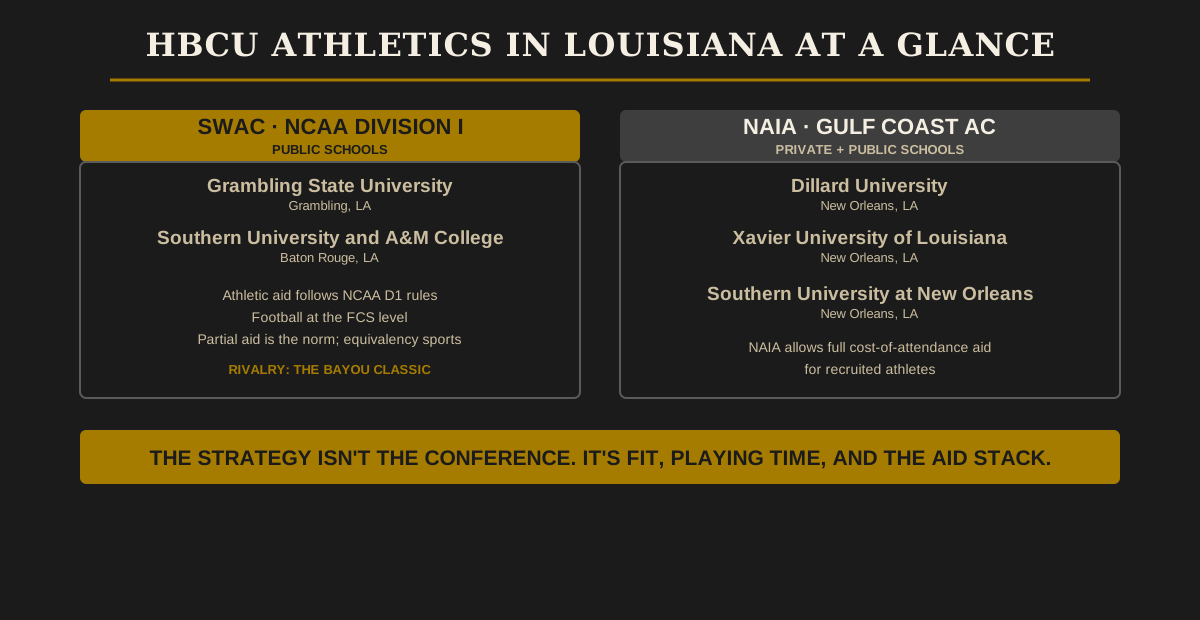
| School | Type | Conference | Division | Best known for |
| Grambling State (Grambling) | Public | SWAC | NCAA Division I | Football tradition, NFL pipeline, Eddie Robinson legacy |
| Southern University and A&M College (Baton Rouge) | Public | SWAC | NCAA Division I | Bayou Classic, "The Bluff," Southern University System |
| Dillard University (New Orleans) | Private | Gulf Coast Athletic Conference | NAIA | Academic reputation, basketball |
| Xavier University of Louisiana (New Orleans) | Private | Gulf Coast Athletic Conference | NAIA | Pharmacy and pre-med pipeline, basketball |
| Southern University at New Orleans (SUNO) | Public | Gulf Coast Athletic Conference | NAIA | New Orleans roots, affordability, basketball |
Grambling and Southern play by NCAA Division I rules. That means FCS football, the NCAA Eligibility Center, and the same athletic-scholarship math I describe in the landscape guide. Dillard, Xavier, and SUNO play by NAIA rules. That is a different, often friendlier financial world, and the next section is where it matters most.
3. THE ATHLETIC MONEY: TWO DIFFERENT RULEBOOKS
Most families think one word and one word only: scholarship. I want you to think about the rules, because the rules decide how much money can legally be on the table.
At Grambling and Southern (NCAA Division I):
- Athletic aid is awarded by the NCAA's rules for your sport. In equivalency sports like football and baseball, the coaching staff splits a set number of awards across the roster.
- That means some athletes get a full award and many more get a partial one. Partial is common, not a failure.
- Most athletic aid is year-to-year and renewed at the school's discretion. The scholarship belongs to the school, not the coach.
- Because these are public universities, in-state tuition is already lower, and that makes a partial award stretch further than it would at many private schools.
At Dillard, Xavier, and SUNO (NAIA):
- NAIA rules allow an institution to offer a recruited athlete a full cost-of-attendance award that can cover tuition, fees, room, board, and books.
- That is a real difference. A full outright NAIA award can be larger in effect than a partial NCAA arrangement.
- NAIA schools still award partial packages too. The point is that the math is different, and you should never assume which is bigger until you run the numbers.
Here is the sentence I want you to tattoo on your planner: the athletic award is one layer. It is never the whole picture.
4. THE AID STACK: HBCU-SPECIFIC MONEY ON TOP OF TOPS AND FAFSA
Every Louisiana athlete should already know the base layers, and if you don't, stop here and read the landscape guide. The minimum setup is the same:
- TOPS, Louisiana's merit-based scholarship, applies at all five of these schools. Apply through LOSFA (mylosfa.la.gov).
- The FAFSA is the application for federal grants and loans and for much of what the schools themselves hand out. File it at studentaid.gov, every year, early.
Then the HBCU-specific layer, which is where families leave money on the table:
- UNCF runs scholarships that cover tuition and books at member HBCUs, including Dillard and Xavier. Apply at uncf.org.
- The Thurgood Marshall College Fund (TMCF) supports students at public HBCUs, which includes Grambling, Southern, and SUNO. Check tmcf.org for member scholarships and opportunities.
- Institutional aid sits inside each school's financial-aid office. Merit grants, need-based grants, athletic aid, campus jobs, and emergency funds all live here.
- Program-specific money exists at every one of these schools for certain majors, leadership, and campus involvement. You do not get what you do not apply for.
Stack correctly and the math changes completely. A partial athletic award plus TOPS plus FAFSA plus an HBCU scholarship can pull an out-of-reach number into a family's budget. That is the strategy. I want you to run that stack for every school on your list, because the school that looks expensive on paper is sometimes the one that ends up costing the least.
5. THE HONEST NIL PICTURE AT HBCUs
I keep NIL conversations honest, because hype has drained more wallets than it has filled. Here is what I can tell you with confidence:
- NIL rules apply at HBCUs the same as everywhere. NCAA and state rules govern the same way at Grambling as they do at a Power Five school.
- HBCU athletes are doing real deals. Local businesses, collectives, and regional sponsors work with SWAC and GCAC athletes every season.
- The honest part: HBCU NIL money is usually smaller and more community-driven than the headline Power Five deals. I will not pretend otherwise.
- What that means for strategy: an athlete's NIL value at an HBCU comes from standing out in a smaller market and being easy for local brands to work with. That is exactly the documented-identity work I talk about in being seen versus being remembered.
Check every NIL agreement against your state's rules and your school's compliance office before signing. A follow-through athlete with a local following can make more real money than a name that went viral once and never translated into trust.
6. RECRUITING REALITY: HOW YOU ACTUALLY GET SEEN BY AN HBCU
Coaches at HBCUs recruit like every other staff: they work their networks, they watch film, they attend camps, and they build relationships with high school coaches. What changes is volume and access.
- Register for the NCAA Eligibility Center if you are targeting Grambling or Southern. Division I athletes cannot be offered or signed without clearing that first. Start early; my checklist walks through the order of operations.
- NAIA schools (Dillard, Xavier, SUNO) use a lighter registration path. Ask the coach and the admissions office what they need from you and when.
- Send more than highlights. Academic grades, core-course progress, character references, and a documented athletic file separate you from the crowd. I build this kind of file for a living.
- Show up. Camps, showcases, official and unofficial visits, the HBCU college fairs and recruiting events that come through Louisiana. Coaches remember who was in the building.
- Talk to the high school coach early. Louisiana high school coaches know these staffs personally. The LHSAA pipeline is real, and the comparison is lazy for a reason: it works.
The Bayou Classic and the SWAC football stage are national spotlights. If you are one of the athletes on that field, the platform is enormous, and the cameras and scouts watching are not all from HBCUs. Playing at a school like Southern or Grambling has opened NFL doors for generations. Division is not destiny. Production on stage is.
7. THE FIT QUESTION: THE SCHOOL IS NOT THE ONLY DECISION
The same advice I give in the pillar guide applies here with extra force. An athletic offer is not an education plan, and a school is not the only decision. When you compare HBCUs to other options, compare all of it:
- The degree. Xavier is nationally known for its pharmacy and pre-med pipeline. Grambling's business and college programs have long histories. Southern's education and engineering programs feed Louisiana schools and industry. What does the athlete actually want to become?
- Graduation support. What tutoring, study halls, and academic advising exist for athletes at each school? Ask, and ask the athletes who already play there.
- The role. Is this athlete legitimately competing for playing time, or depth on a roster? Be honest about it.
- The culture. Does the athlete want the HBCU experience, the community, the traditions, the brotherhood of the marching band and the weekend campus? For some athletes this is the difference between thriving and surviving.
- The cost outcome. Run the full aid stack for every school and compare remaining debt, not sticker price.
My opinion, as someone who thinks about markets and identity every day: the school that matches the athlete's sport, major, culture, and budget is a better bet than the school that only matches the name.
8. THE COLD WATER, BECAUSE YOU DESERVE IT
I am not going to sell you a fantasy, because fantasies don't pay tuition:
- Playing time is not guaranteed anywhere, including HBCUs. Coaches sign who they think wins games, and conference competition is real.
- Full-ride HBCU offers are rarer than the highlight reels suggest. Expect partial awards, stacked with everything else, and plan a budget that survives a partial year.
- Renewal is year-to-year, at HBCUs and everywhere else. An injury, a coaching change, or a compliance issue can change everything in one season.
- NAIA and NCAA rules are different, and mistakes are expensive. A rule error can cost eligibility faster than a coach can explain it. Verify with the school and the association's official materials.
- HBCU NIL money is real but modest. Build the identity and the local relationships; do not build your budget on a deal you have not signed.
What if the athlete gets hurt? The question I always end on, and the reason the degree and the school matter so much. The scholarship is temporary. The education and the network are forever, and HBCU alumni networks are some of the most loyal in America.
MY BOTTOM LINE
When a Louisiana family tells me they are "only" looking at one kind of school, I hear a family that has limited its own options. The state gives you five HBCUs across two athletic worlds, and I would put Grambling and Southern against almost any mid-major conference in the country for national identity, tradition, and NFL history.
My recommendation: put every school on the list that fits the sport, the major, the culture, and the budget. Run the aid stack for each one. Build the documented identity. Contact the coaches. And do not let anyone, including me, pick your school for you.
The scholarship isn't the strategy. The strategy is knowing the full market, meeting the requirements, and making the fit obvious. Louisiana families at HBCUs understand that better than most, because they have been building opportunity instead of waiting for it for a hundred years.
SOURCES AND REFERENCES
The facts in this post reflect the rules as I verified them in September 2026. These are summaries in my own words, not reproductions of copyrighted material. Always check the official sources directly, because eligibility and financial-aid rules change:
- NCAA Eligibility Center: core-course and GPA requirements and the age-based rule transition.
- Southwestern Athletic Conference (SWAC): Grambling State and Southern University conference and rules.
- Gulf Coast Athletic Conference: Dillard, Xavier, and SUNO conference home.
- NAIA (naia.org): eligibility and financial-aid rules for NAIA programs.
- LOSFA (mylosfa.la.gov): Louisiana TOPS and state financial-aid programs.
- FAFSA (studentaid.gov): the federal application required for federal and many state and institutional aid programs.
- UNCF (uncf.org): scholarships serving member HBCUs including Dillard and Xavier.
- Thurgood Marshall College Fund (tmcf.org): scholarships and support for students at public HBCUs including Grambling, Southern, and SUNO.
- LHSAA (lhsaa.org): eligibility and sanctioning for Louisiana high school athletics.
KEEP EXPLORING THE WORK
This article is part of a conversation I keep having about Louisiana sports and student-athletes. Start with The Scholarship Is Not the Strategy, the landscape guide to D1, D2, D3, JUCO, and every layer of Louisiana's college directory. When you are ready to execute, work through the step-by-step scholarship and recruiting checklist. Then read my breakdown of the college sports NIL executive order, learn why being seen isn't the same as being remembered, and go deeper into where this thinking comes from in Who Is Jaylen Sinegal?. Everything on Jay's Blog orbits the same idea: people who understand their market and build their identity don't have to wait to be discovered.